
In the Presence: Blind Obedience & Lively Faith
In the sixth month the angel Gabriel was sent by God to a town in Galilee called Nazareth, to a virgin engaged to a man whose name was Joseph, of the house of David. The virgin’s name was Mary. And he came to her and said, “Greetings, favored one! The Lord is with you.” But she was much perplexed by his words and pondered what sort of greeting this might be. The angel said to her, “Do not be afraid, Mary, for you have found favor with God. And now, you will conceive in your womb and bear a son, and you will name him Jesus. He will be great, and will be called the Son of the Most High, and the Lord God will give to him the throne of his ancestor David. He will reign over the house of Jacob forever, and of his kingdom there will be no end.” Mary said to the angel, “How can this be, since I am a virgin?” The angel said to her, “The Holy Spirit will come upon you, and the power of the Most High will overshadow you; therefore the child to be born will be holy; he will be called Son of God. And now, your relative Elizabeth in her old age has also conceived a son; and this is the sixth month for her who was said to be barren. For nothing will be impossible with God.” Then Mary said, “Here am I, the servant of the Lord; let it be with me according to your word.” Then the angel departed from her.
The Annunciation from the Gospel of Luke introduces us to Mary’s faith-filled obedience and trust in God.
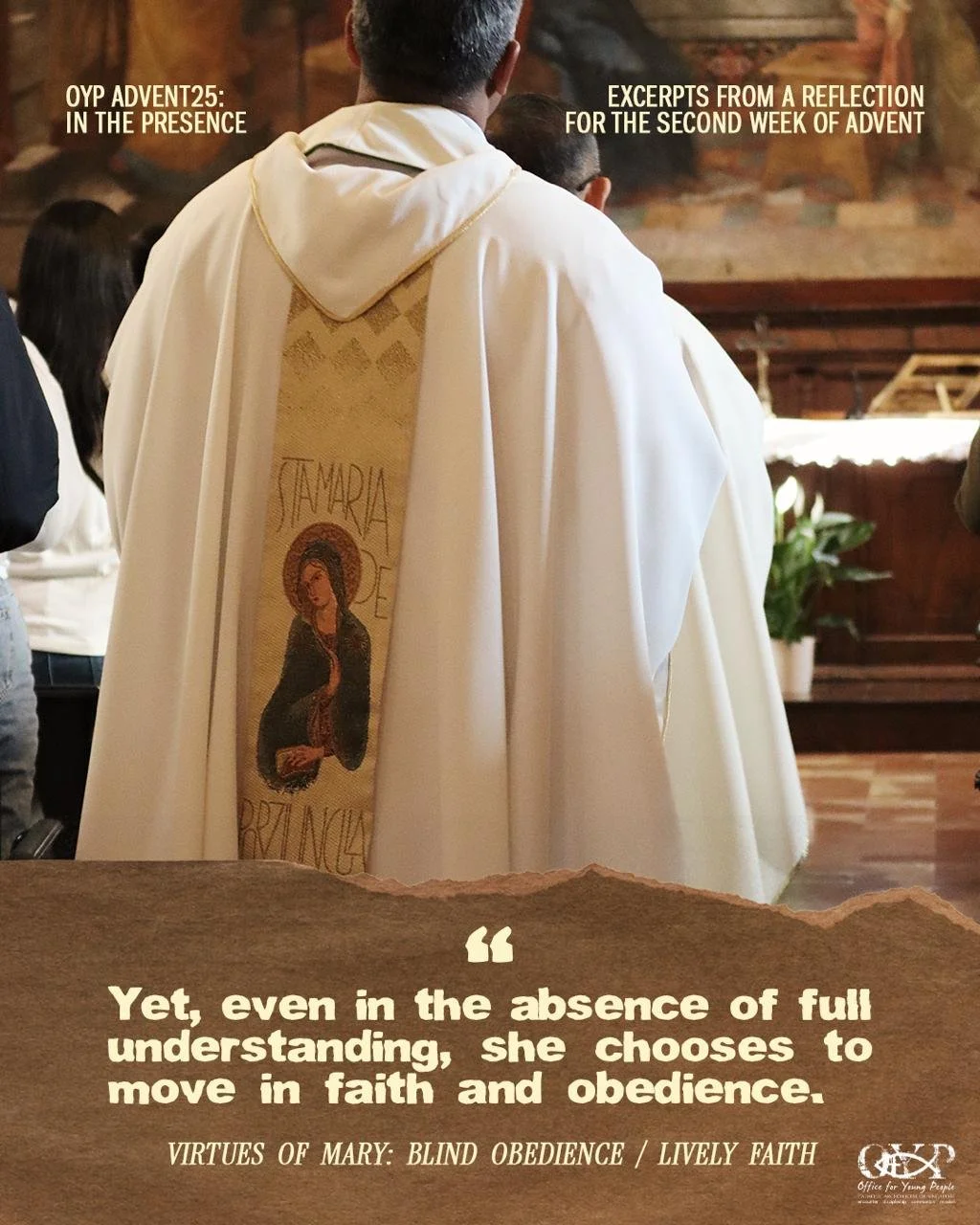
“Here I am, the servant of the Lord; let it be with me according to your word.” (Luke 1:38) reveals the profound depth of her faith and obedience. An obedience that is brought about through her disposition of openness and active trust despite the unknown and uncertainty of the future. Mary’s obedience is blind, not in a passive sense, but in that she trusted in God even when His will was beyond her understanding. She approaches God’s invitation with sincerity and a desire to understand in order to give her fiat freely. Yet, even in the absence of full understanding, she chooses to move in faith and obedience.
Reflecting on this passage, the process of listening, pondering, and understanding God’s invitations continually touches every area of life. Yet, beneath this process lies the fundamental need of a disposition of openness and trust in order to respond with obedience. Earlier this year, I was blessed to take two months off my corporate work to attend the School of Witness. I desired the time to grow deeper in my relationship with God and to seek clarity on my future, and more specifically, in my career. It became a season of unlearning false narratives about my identity, growing a heart of gratitude, and cultivating new habits of listening in prayer, pondering God’s movements, and seeking wise counsel.
Shifting from praying for my own wishes—especially my desire to leave my current job because of the many challenges I faced—to praying for what God desires for me was difficult. But it became an essential step in learning to trust His plans, even when they are different from what I want. Through many prayers and reflections, it became clear that His invitation, at that time, was to return to my current job. This realisation initially brought about frustration and hesitation, rooted in my reluctance to face those challenges again and in my fear of what returning might mean for my future.
During a time of reflection, this verse spoke out to me and brought comfort to my fearful heart: “And I will ask the Father, and he will give you another Advocate, to be with you always, the Spirit of truth, … But you know it, because it remains with you, and will be in you. I will not leave you orphans; I will come to you.” (John 14: 16-18). Similarly, Angel Gabriel assured Mary that the Holy Spirit would be with her, protecting and guiding her: “The Holy Spirit will come upon you, and the power of the Most High will overshadow you” (Luke 26:35). The Spirit that was with Mary through and beyond her pregnancy, is the same Spirit who is with each of us. He promises to remain by us even when times get trying. Upon recognising and believing in this truth gave me a sense of confidence to move out of my fears and respond in trust and obediently.
Just as Mary placed her trust in God despite not knowing what the future would hold, I am learning to surrender my own uncertainties to Him—one small “yes” at a time. Her fiat shows me that true obedience does not require having all the answers, but believing that God remains with us even when the path ahead is unclear. In the words of St. Padre Pio, “My past, O Lord, to Your mercy; my present, to Your love; my future, to Your providence.”
As we journey further into Advent, let us follow Mary’s example, giving our own fiat to the Lord. Like her, may we cling onto the truth that every part of our lives is secure in God’s faithful and merciful hands. The Holy Spirit goes with us and strengthens us, reminding us that God’s plans—though often unexpected—are always rooted in His steadfast love.